LoRaWAN.
The global standard for serious remote monitoring.
Used by municipalities, utilities and operations across more than 170 countries. LoRaWAN (Long Range Wide Area Network) is a radio communication protocol designed to wirelessly connect battery-powered devices to the internet over long distances. It allows IoT devices to transmit data efficiently where conventional connectivity falls short — making it ideal for smart cities, agriculture, utility monitoring and industrial applications.
Setting up your own
LoRaWAN network.
A LoRaWAN network has two essential components — the sensors or data loggers that monitor your assets, and the gateway that connects everything to the internet. Understanding the role of each makes the whole system immediately clear.
Sensors & Data Loggers
Small, battery-powered devices attached directly to your assets — a water meter, a tank, a borehole, a pump. They measure what matters and transmit that data wirelessly via LoRa radio. No Wi-Fi. No SIM card. No cables at the sensor end. These are the relatively inexpensive part of the system.
The LoRaWAN Gateway — the hub of your system
The gateway bridges your sensors and the internet. It receives the radio signals from every sensor in range, converts them into data, and forwards that data to a secure cloud server — and ultimately your dashboard. Without a properly set up gateway, your sensors are silent. The performance of your entire LoRaWAN network depends on it.
From sensor to screen —
how data moves.
Each sensor transmits a short radio pulse. The gateway receives it, decodes it, and forwards it to a secure cloud server via its own internet connection. From there it reaches your dashboard — live, anywhere, on any device.
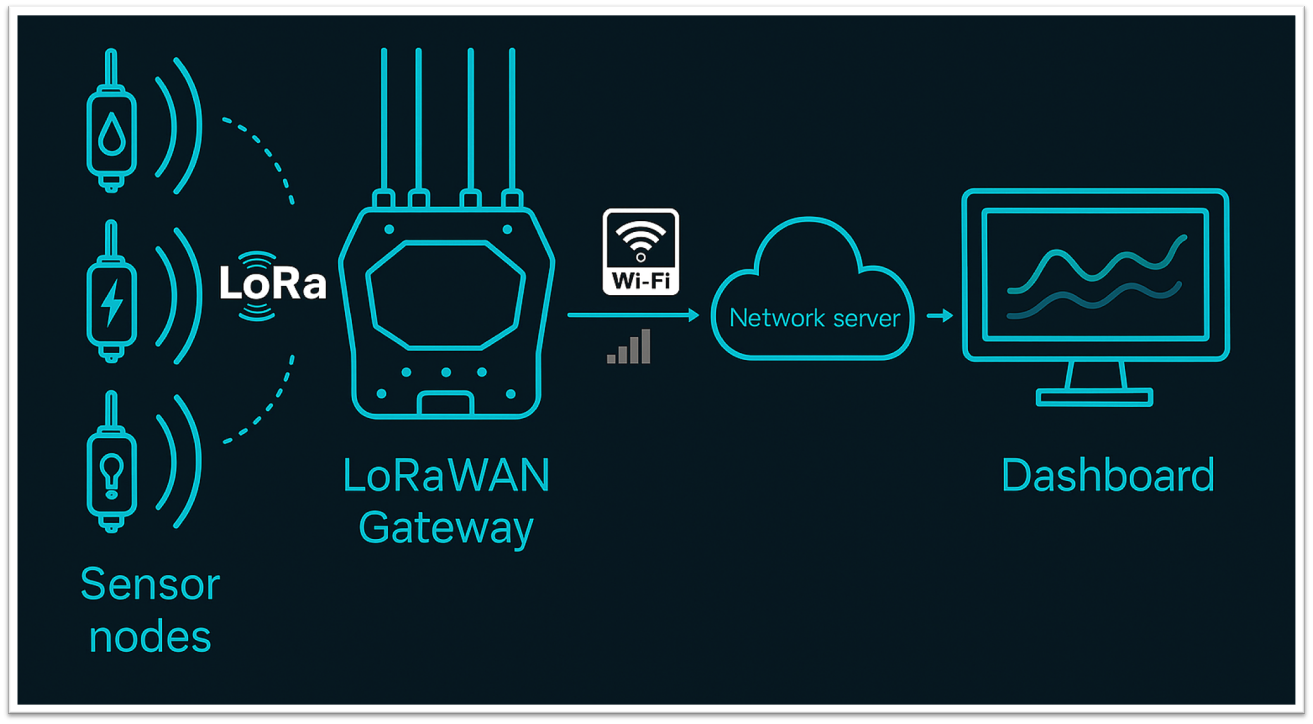
✦ The gateway is the critical link. Sensors transmit wirelessly to it via LoRa radio — it then forwards everything to the cloud via its own separate internet connection.
The gateway is not a device.
It's the hub of your system.
The right gateway depends entirely on what you need to cover. A compact site is very different to a farm where monitoring points are spread across large distances.
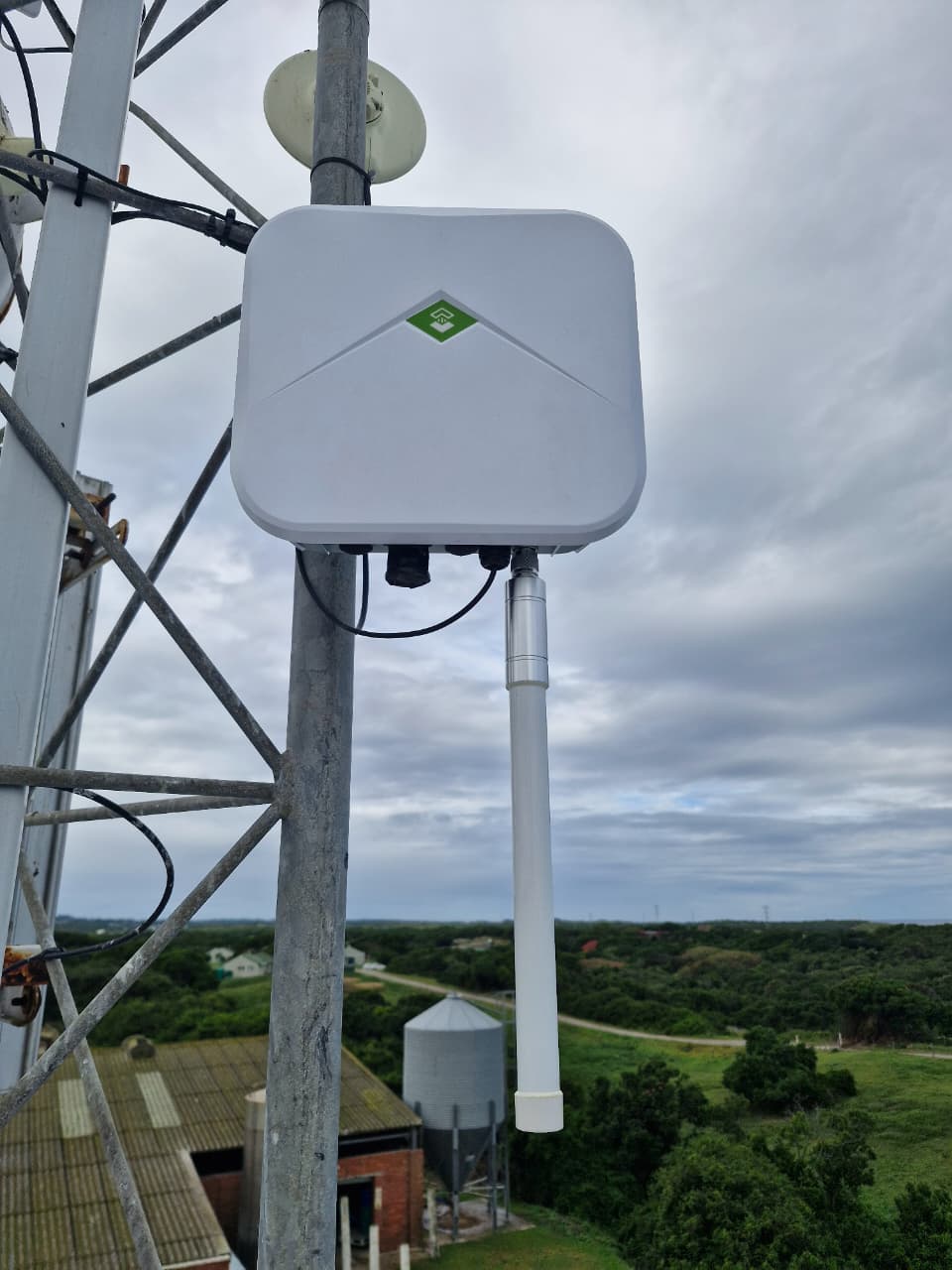
Mounted high. Covering far.
For large-area coverage a gateway needs to be installed outdoors and elevated — mounted on any existing high point on your property. A rooftop, a water tower, a grain silo, an existing pole. No new structure is required. For smaller sites where sensors are close together, a simple desktop indoor gateway connecting to existing Wi-Fi or Ethernet may be all that's needed.
- Mounts to any existing high point — no new structure needed
- Elevation and clear line-of-sight determine coverage
- Outdoor IP-rated enclosure for heat, rain, dust and long-term exposure
- Requires its own internet connection — 4G/LTE, Wi-Fi or Ethernet
- Commercial-grade hardware from reputable manufacturers
Coverage is always confirmed in the field. Terrain, buildings and vegetation all affect real-world signal range in ways no map can predict. A site survey and field test is part of every Wild Data deployment.
You're not buying into a system.
You're investing in a universal standard.
LoRaWAN is an open, globally standardised protocol governed by the LoRa Alliance — not owned by any single company. Your hardware is not tied to us, or to anyone else.
Closed / Proprietary IoT
- ✕ Sensors only work with that vendor's platform
- ✕ Locked to one cloud — if they shut down, you start over
- ✕ Hardware cannot be repurposed or resold
- ✕ Low entry cost — expensive long-term trap
LoRaWAN — Open Standard
- ✓ Any LoRaWAN-compatible device works on your gateway
- ✓ Change provider — your hardware comes with you
- ✓ Hardware can be repurposed, redeployed or resold
- ✓ Higher entry cost — permanent, transferable asset
LoRaWAN compared to
what you already know.
Nobody questions why a cell tower costs what it costs to build and maintain. Apply that same thinking to LoRaWAN and the economics make immediate sense.
| LoRaWAN Component | Wi-Fi Equivalent | Telecoms Equivalent | Its Role |
|---|---|---|---|
| LoRaWAN Gateway | Router | Cell tower / regional hub | The backbone |
| Sensor / Data Logger | Laptop or phone on Wi-Fi | Mobile phone on the network | The device |
| LoRa Radio Signal | Wi-Fi signal | Cellular signal (3G / 4G) | The connection |
| Cloud / Network Server | The internet | The telecoms backbone | The data highway |
| Dashboard & Alerts | Your apps and browser | Your phone's interface | What you see |
One gateway.
Your entire operation.
LoRaWAN is designed for networks of sensors. The gateway is a fixed infrastructure investment — everything you connect to it is incremental. Whether you're running one sensor or a hundred, the network cost stays the same.
Gateway. That's it.
One properly set up gateway covers your entire operation — now and as you scale. The infrastructure cost doesn't grow as your sensor count does.
Devices. One network.
A single gateway could potentially handle upwards of 100 sensors simultaneously. Adding a new monitoring point means buying a sensor — not rebuilding your network.
Cost per device drops as you grow.
Three sensors today, thirty next year. Each addition lowers your cost-per-monitoring-point. The system is designed to reward growth — not penalise it.
Built for open terrain.
Ideal for rural South Africa.
Open, rural environments
LoRaWAN performs at its best in open terrain — farmland, game reserves, rural estates. With line-of-sight between sensor and gateway, signals travel reliably over large distances on minimal power. This is exactly the environment where Wi-Fi and 4G fall short. In a rural setting, LoRaWAN isn't a compromise — it's the correct engineering choice.
Built-up and obstructed areas
Walls, buildings and dense vegetation all reduce effective signal range. In urban or obstructed environments, coverage decreases and multiple gateways may be needed. This is a characteristic of all radio systems — not unique to LoRa — and it's why a proper site survey is part of every Wild Data installation.
Not just hardware.
A complete, managed solution.
We handle the full picture — gateway installation, sensor deployment, cloud configuration, custom dashboards, automated alerts and monthly reporting. We are not a hardware supplier. We are the team that makes the whole system work, and keeps it working.
Wild Data is technology-agnostic. We work with Wi-Fi, 4G, Ethernet, Modbus, Bluetooth and more. LoRaWAN is simply the tool we most often recommend when reliable monitoring is needed across remote or off-grid locations — because it consistently delivers where everything else cannot.
Ready to discuss your project?
Tell us about your operation and what you're looking to monitor. We'll give you an honest assessment of what's possible and what it realistically involves.